INTRODUCTION
Expert opinion, (one example is the British Journal of Urology), regularly states that chronic pelvic pain (CPP) has no known pathogenesis or cure. Such statements are challenged by data from the posterior fornix syndrome (PFS) paradigm “PFS”, (co-occurring CPP, urge, frequency, nocturia (now “OAB”), abnormal bladder emptying/retention) caused by uterine/apical prolapse (even of minor degree), and cured by native uterosacral ligament (USL) repair (see rectangle, algorithm, ). Nor is CPP “incurable”. There are copious data of CPP cure by USL laxity, when part of the PFS paradigm ().-
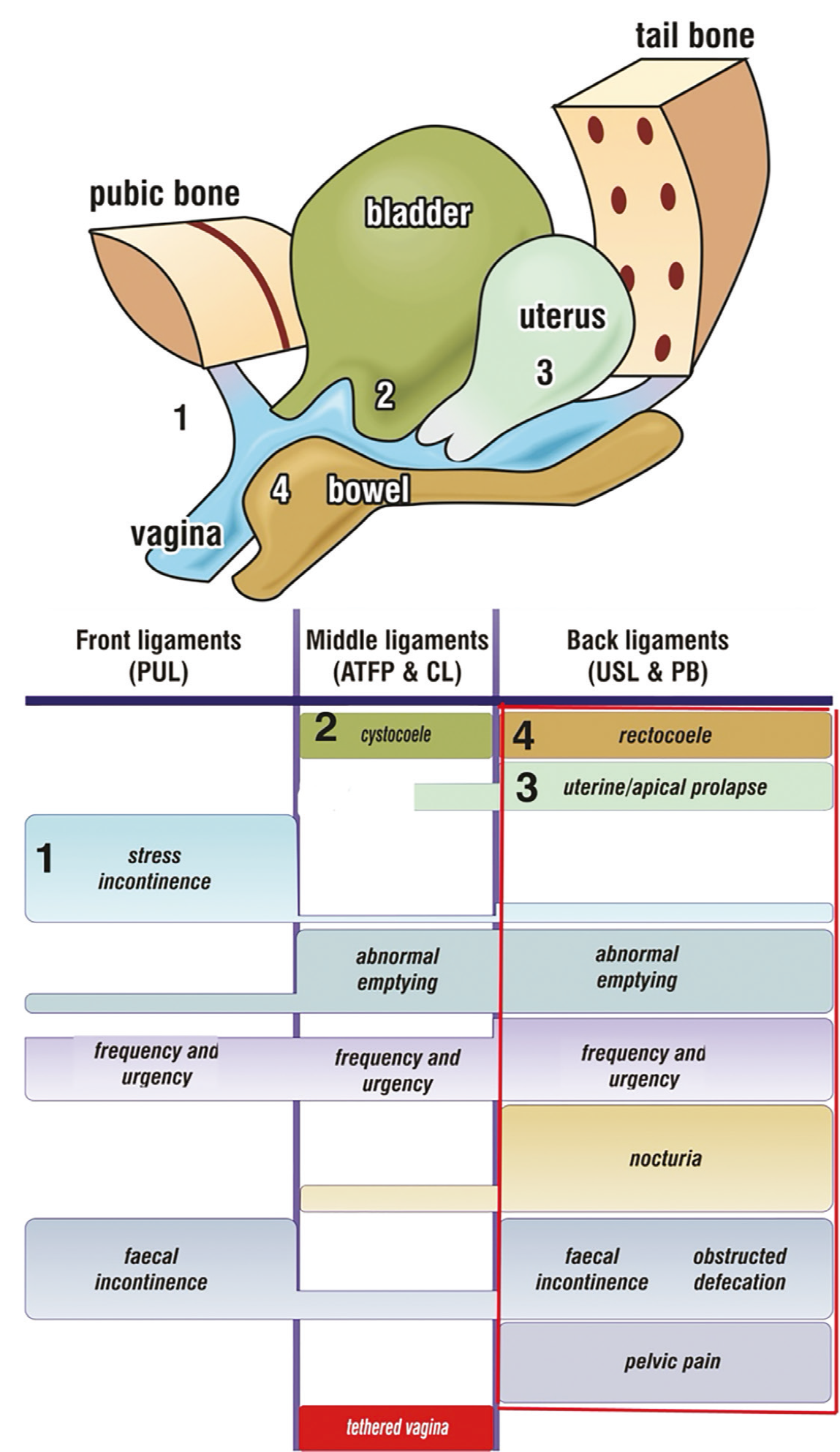
Lax USLs as cause of CPP was reported for the first time in the German literature in 1938 by Heinrich Martius, and independently for the first time in the English literature by Peter Petros 60 years later, in 1996. In a laparoscopically controlled trial, Petros reported 70% cure of CPP at 12 months by native tissue USL plication. He also reported relief of CPP in 50% of women with ring pessaries. Petros hypothesized that CPP originated from inability of lax uterosacral ligaments to support visceral nerve plexuses. These fired off afferent impulses which were interpreted by the cortex as pain originating in the end organ, .
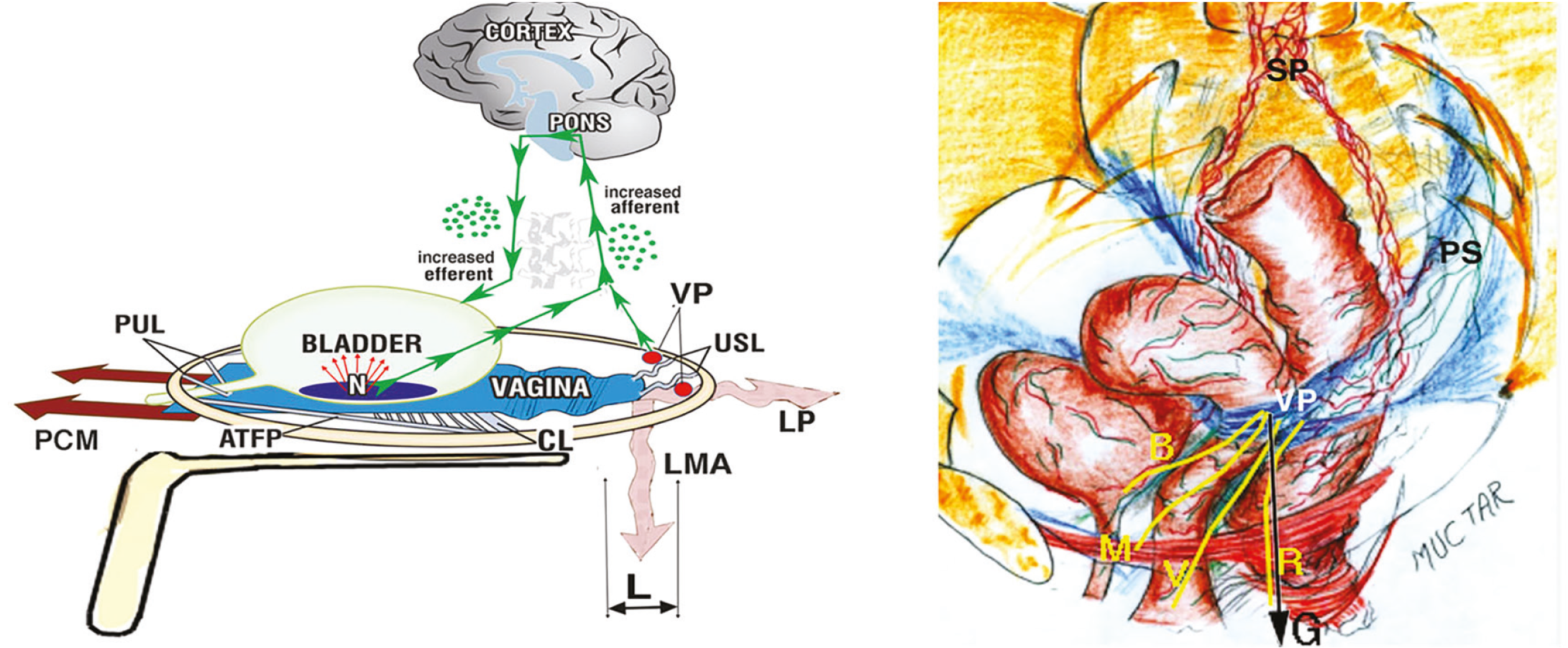
A speculum inserted into the posterior fornix mechanically supports lax USLs, the visceral nerve plexuses (VP) S2-4, T11-L2 and also, the stretch receptors “N”, to decrease afferent impulses to the micturition centre of the brain, which are interpreted as urgency from “N” and pain from “VP”. Right figure: Visceral plexus (VP) with components “SP” (sympathetic T11–L2) and parasympathetic “PS” (S2-4). Endorgan afferent visceral nerves M (muscles), B (bladder), V (vagina), R (rectum) travel to VP where they group (explaining co-occurrence of endorgan site pain); VP serves as a type of relay junction. G signifies forces of gravity acting on these nerves in the upright position. If they are unsupported by competent USLs, the VPs can directly fire off signals to the brain which are interpreted as pain arising from the end organs such as M,V,P, R and lower abdomen. Right figure by permission, Muctar S.
DIAGNOSIS
CPP of unknown origin requires co-occurrence of urge or emptying symptoms (see rectangle, diagnostic algorithm, . The speculum test, , mechanically supports the USLs, and therefore, the visceral plexuses (VP).
Uterosacral ligament causation for CPP is easily tested. The speculum test, when it works, relieves multiple pain sites simultaneously. As such, it is a predictive test for cure of CPP by USL repair.
The definitive test for USL causation of CPP is the Bornstein test, local anesthetic (LA) injected transvaginally into the proximal end of USLs. LA anaesthetizes the VPs, and relieves multiple pain sites simultaneously.
TREATMENT
“Repair the structure and you will restore the function”- Integral Theory.
Younger women with CPP are potentially curable by USL native tissue plication. Older women have collagen deficiency and require a posterior sling or wide-bore polyester plication of USLs ().
Footnotes
Conflict of Interest: The author of this article (P.P.) is a member of the Editorial Board of this journal. He was completely blinded to the peer review process of the article.
Financial Disclosure: The author declared that this study received no financial support.
References
Parsons BA, Baranowski AP, Berghmans B, et al. Management of chronic primary pelvic pain syndromes. BJU Int. 2022; 129: 572-81.
Petros PE, Ulmsten U. The posterior fornix syndrome: a multiple symptom complex of pelvic pain and abnormal urinary symptoms deriving from laxity in the posterior fornix. Scand J Urol Nephrol. 1993; 27: 89-93.
Petros PP. Severe chronic pelvic pain in women may be caused by ligamentous laxity in the posterior fornix of the vagina. Aust N Z J Obstet Gynaecol. 1996; 36: 351-4.
Goeschen K, Gold DM. Surgical cure of chronic pelvic pain, associated bladder & bowel symptoms by posterior sling in 198 patients validates the Pescatori Iceberg principle of pelvic symptom co-occurrence. Pelviperineology. 2017; 36: 84-8.
Goeschen K, Gold DM, Liedl B, Yassouridis A, Petros P. Non-hunner’s interstitial cystitis is different from hunner’s interstitial cystitis and may be curable by uterosacral ligament repair. Urol Int. 2022; 106: 649-57.
Sekiguchi Y, Inoue H, Liedl B, et al. Is chronic pelvic pain in the female surgically curable by uterosacral/cardinal ligament repair? Pelviperineology. 2017; 36: 74-8.
Goeschen K. Role of uterosacral ligaments in the causation and cure of chronic pelvic pain syndrome. Pelviperineology. 2015; 34: 2-20.
Marcus Braun N, von Theobald P. Chronic pelvic pain caused by laxity of the uterosacral ligaments: are the posterior fornix syndrome and the Allen-Masters syndrome synonyms? Pain Med. 2016; 17: 370-1.
Abendstein B, Brugger C, Furtschegger A, Rieger M, Petros P. Study no. 12: role of the uterosacral ligaments in the causation of rectal intussusception, abnormal bowel emptying, and fecal incontinence. A prospective study. Pelviperineology. 2008; 27: 118-21.
Inoue H, Kohata Y, Fukuda T, et al. Repair of damaged ligaments with tissue fixation system minisling is sufficient to cure major prolapse in all three compartments: 5-year data. J Obstet Gynaecol Res. 2017; 43: 1570-7.
Liedl B, Goeschen K, Sutherland SE, Roovers JP, Yassouridis A. Can surgical reconstruction of vaginal and ligamentous laxity cure overactive bladder symptoms in women with pelvic organ prolapse? BJU Int. 2019; 123: 493-510.
Himmler M, Rakhimbayeva A, Sutherland SE, Roovers JP, Yassouridis A, Liedl B. The impact of sacrospinous ligament fixation on pre-existing nocturia and co-existing pelvic floor dysfunction symptoms. Int Urogynecol J. 2021; 32: 919-28.
Petros P, Abendstein B, Swash M. Retention of urine in women is alleviated by uterosacral ligament repair: implications for Fowler’s syndrome. Cent European J Urol. 2018; 71: 436-43.
Martius H. Über einen häufigen gynäkologischen symptomkomplex. Arch Gynak. 1938; 166: 332-5. German.
Wu Q, Luo L. Petros PP Mechanical support of the posterior fornix relieved urgency and suburethral tenderness. Pelviperineology. 2013; 32: 55-6.